

As an MRO Manager or Senior Procurement Engineer, you understand that the health of your machinery is the lifeblood of your operation. Unplanned downtime is more than an inconvenience; it's a direct hit to your bottom line. This article is your deep dive into one of the most powerful tools in predictive maintenance: bearing vibration analysis, with a specific focus on the crucial gE value. We will explore what this measurement is, how to interpret it, and how you can leverage it to prevent catastrophic equipment failure, extend the lifespan of your components, and ensure the consistent reliability your company depends on. At VPK Bearing, we don't just manufacture bearings; we provide the expertise to help our partners succeed.
What is Bearing Vibration Analysis and Why Does It Matter?
At its core, vibration analysis is the process of measuring the vibration signals from a machine, processing that data, and using the information to determine the health of the machine and its components. Think of it as a doctor using a stethoscope to listen to a patient's heartbeat. Every rotating machine, from a massive industrial gearbox to a small electric motor, generates a unique vibration "signature" when it's in good working condition. When a component like a bearing begins to fail, it introduces new, distinct vibrations into that signature.
For a manager like you, Richard, this is not just abstract science. It's a practical, non-invasive way to look inside your machinery while it's running. By establishing a baseline of normal vibration and then monitoring for changes, you can:
- Detect faults early: Identify issues like bearing wear, misalignment, or imbalance long before they become critical failures.
- Prevent catastrophic damage: A failing bearing can destroy shafts, housings, and other expensive parts if left unchecked.
- Plan maintenance effectively: Instead of reacting to breakdowns, you can schedule repairs during planned downtime, saving immense costs.
- Increase safety: Preventing unexpected equipment failure protects your personnel and your facility.
The reliability of every mechanical system depends on the health of its smallest parts. A single faulty bearing can halt an entire production line. That’s why understanding the data from vibration analysis is a cornerstone of modern industrial maintenance.
What Exactly is the gE Value in Bearing Vibration?
Now, let's get specific. You might see various measurements in a vibration report: velocity, displacement, acceleration. But one of the most powerful for bearing diagnostics is the gE value, also known as "enveloped acceleration" or "acceleration enveloping." This is a specialized measurement technique pioneered by companies like SKF.
So, what is it? Imagine a tiny flaw on a bearing race. Every time a rolling element passes over that flaw, it creates a small, high-frequency impact or "click." In a noisy industrial environment, these tiny clicks are drowned out by the machine's normal, low-frequency vibrations (like humming and rumbling). The gE technique acts like a special filter. It ignores the loud, low-frequency background noise and isolates only the high-frequency "impact" energy generated by the bearing fault. This energy is then processed to produce a single, simple value: the gE value.
A rising gE value is often the very first warning sign that a bearing is in distress. It can detect microscopic faults that standard vibration measurements might miss, giving you the earliest possible warning of impending failure. This is precisely the kind of reliable, early-warning data that a detail-oriented manager needs to prevent costly surprises.
How is the gE Enveloped Acceleration Measurement Taken?
Collecting accurate gE data is a straightforward process, but it requires the right tools and techniques. The primary tool is an accelerometer, a sensor (often magnetic) that is placed directly onto the bearing housing of the machine. This accelerometer converts the mechanical motion of vibration into an electrical signal.
This signal is then fed into a data collector, such as an SKF Microlog analyzer. Here’s a simplified breakdown of what happens inside the collector to generate the gE value:
- Data Acquisition: The accelerometer picks up the full range of vibrations from the bearing.
- High-Pass Filtering: The system applies a filter to remove all the low-frequency vibrations associated with normal machine operation (like shaft rotation and imbalance).
- Enveloping (Demodulation): The remaining high-frequency signal, which contains the impacts from the bearing fault, is processed. The "envelope" of this signal is created, which essentially traces the peak amplitude of the impacts.
- Low-Pass Filtering & FFT: This enveloped signal is then filtered again and analyzed using a Fast Fourier Transform (FFT) to create a spectrum. This spectrum shows the rate at which the impacts are occurring.
- gE Reading: The overall energy within a specific frequency range of this final spectrum is calculated to produce the final gE value.
This measurement provides a clear, trendable number. By taking a periodic reading from the same point on a machine, you can monitor the bearing condition over time and act before a problem escalates.
What are the Characteristic Frequencies of a Failing Bearing?
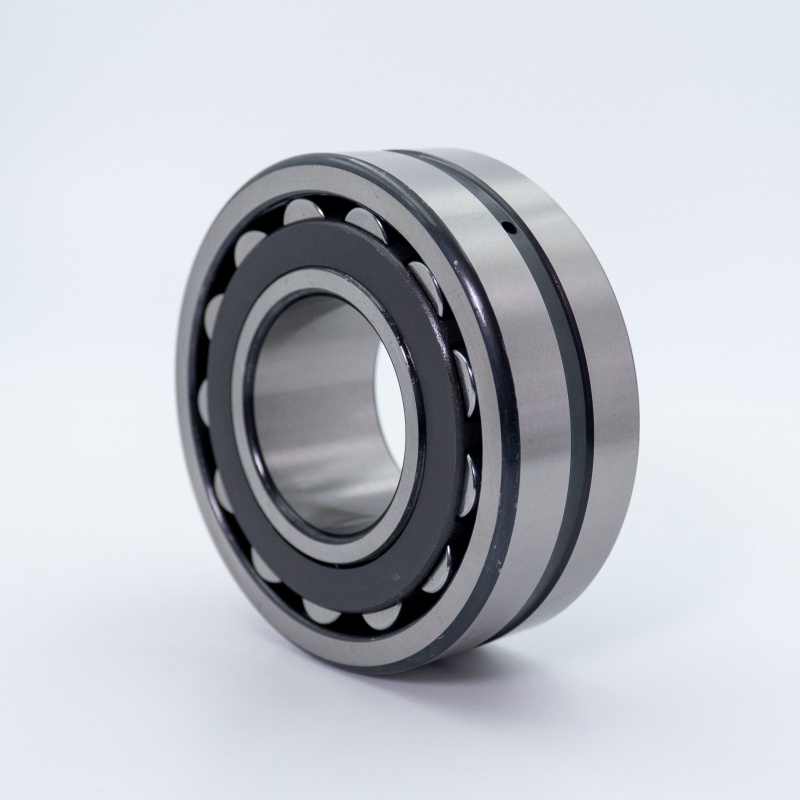
While the overall gE value gives you a great indication of a problem's severity, the gE spectrum provides the diagnostic detail to pinpoint the exact location of the fault. A rolling element bearing has four main components that can fail, and each one generates impacts at a unique, predictable frequency when it rotates.
These are known as the Bearing Fault Frequencies:
- Ball Pass Frequency, Outer Race (BPFO): The rate at which rolling elements pass over a single point on the outer race. This is the most common bearing fault.
- Ball Pass Frequency, Inner Race (BPFI): The rate at which rolling elements pass over a single point on the inner race.
- Ball Spin Frequency (BSF): The rotational frequency of a single rolling element (the ball or roller itself).
- Fundamental Train Frequency (FTF): The rotational frequency of the cage that holds the rolling elements.
When you see a significant peak in the gE spectrum, you can match its frequency to one of these calculated fault frequencies. For example, if you see a strong peak at the BPFO, you can be highly confident that there is damage on the outer race of that specific bearing. This level of diagnostic precision is invaluable for planning the correct repair.
How Do You Interpret gE Value Readings for Different Bearing Applications?
A common question we get at VPK Bearing is, "What is a 'good' or 'bad' gE value?" The answer isn't a single number; it depends heavily on the application. A high-speed, lightly loaded motor will have a much different vibration signature than a slow-moving, heavily loaded conveyor pulley.
Here is a general framework for interpreting gE readings:
| gE Level (gE) | Bearing Condition | Recommended Action |
|---|---|---|
| 0 - 0.5 | Excellent / Good | No action needed. Continue with routine monitoring. This is the ideal condition for a new, properly installed bearing. |
| 0.5 - 1.5 | Acceptable / Minor Fault | Monitor the bearing more frequently. A minor fault may be present. Check lubrication and temperature. |
| 1.5 - 4.0 | Significant Fault / Warning | A clear fault exists. Plan for replacement at the next scheduled maintenance opportunity. Analyze the spectrum. |
| > 4.0 | Severe Fault / Danger | The bearing is in the final stages of failure. Immediate action is required to prevent catastrophic damage. |
Important Considerations:
- Establish a Baseline: The most reliable method is to take a reading when a bearing is new and known to be in good condition. This baseline becomes your reference point.
- Trend, Don't React: A single high reading can be an anomaly. The real power of vibration analysis lies in trending the data over time. A steady and consistent rise in the gE value is a sure sign of a developing problem.
- Machine Speed: The severity alarms should be adjusted based on the machine's rotational speed. Slower machines naturally have lower gE levels.
As a manufacturer of a wide variety of industrial bearings, we understand how different loads and speeds impact component life. That's why we always recommend establishing application-specific alarm levels.
What Key Factors Influence gE Readings Beyond Bearing Condition?
While the gE value is an excellent indicator of bearing health, it's crucial to understand that other mechanical issues can also influence the reading. A skilled analyst must consider these factors to make a correct diagnosis and avoid misinterpreting the data.
Here are some other conditions that can generate high-frequency energy and affect your gE measurement:
- Lubrication Problems: This is a major one. Insufficient or degraded lubrication causes metal-to-metal contact, which generates impacts similar to a physical fault. We'll explore this more in the next section.
- Gear Mesh Issues: In a gearbox, the meshing of gear teeth can generate high-frequency vibrations that may be picked up by an accelerometer on a nearby bearing.
- Misalignment: Severe angular or parallel misalignment can put an unusual load on the bearing, causing stress and generating high-frequency noise.
- Pump Cavitation: In fluid systems, the formation and collapse of vapor bubbles (cavitation) can create impact-like energy that travels through the machine structure.
- Loose Components: A loose bearing in its housing or other loose mechanical parts can cause rattling or fretting, which also elevates the gE level.
This is why it's important to look at the full picture. Correlating the gE data with other vibration data (like velocity spectra), temperature readings, and visual inspections is key to accurate root cause analysis.
Can gE Analysis Differentiate Between Lubrication Issues and Bearing Wear?
Yes, it often can, and this is another powerful feature of the gE technique. While both poor lubrication and physical bearing damage cause the gE value to increase, they show up differently in the data.
A lubrication problem typically manifests as a "carpet" of raised noise across a broad range of the high-frequency spectrum. It doesn't usually have the distinct, sharp peaks associated with a repeating impact. Think of it as static or white noise. When the grease or oil film breaks down, you get a continuous series of random, microscopic impacts rather than a periodic "click."
In contrast, physical wear or damage (like a spall on a race) will produce clear, defined peaks in the gE spectrum at the bearing's characteristic fault frequencies (BPFO, BPFI, etc.). This is because the impact repeats at a very precise interval with each rotation.
Here’s how you can use this information in practice:
- You see a rising gE value on a critical bearing.
- You look at the gE spectrum.
- Scenario A: You see a broad, raised "noise floor" with no clear peaks. This strongly suggests a lubrication issue. The appropriate action is to grease the bearing and take another reading. If the gE level drops significantly, you've confirmed and solved the problem without replacing the component.
- Scenario B: You see sharp, distinct peaks that correspond to the bearing's BPFO. This indicates physical damage. Greasing will not fix this; the bearing must be scheduled for replacement.
This ability to differentiate saves time, money, and prevents the unnecessary replacement of a perfectly good bearing that was simply starved of lubrication.

What is the Role of the SKF Microlog in gE Data Collection?
The SKF Microlog series is one of the industry-standard portable data collectors for vibration analysis. These rugged devices are essentially specialized computers designed for maintenance professionals to use in the field. At VPK Bearing, we often work with clients who use these systems to monitor the health of our products after installation.
The SKF Microlog is the hardware that makes gE measurement possible. It performs all the complex filtering and processing steps we discussed earlier. A technician selects a pre-programmed measurement point (a "route") on the Microlog, attaches the accelerometer to the machine, and presses a button. The device then automatically collects the necessary data, performs the FFT, calculates the gE value, and stores the reading.
Modern data collectors like the SKF Microlog do more than just collect data. They often have built-in analysis tools:
- On-the-spot Analysis: They can display the spectrum right on the screen, allowing an experienced analyst to make an initial diagnosis in the field.
- Alarm Checks: The device can compare the new reading to pre-set alarm levels and immediately flag a machine that is in a warning or danger state.
- Data Archiving: All measurements are stored and can be uploaded to a computer network for in-depth analysis and long-term trending using software like SKF's @ptitude Analyst.
This combination of a reliable sensor, a powerful data collector like the Microlog, and robust analysis software forms a complete condition monitoring system. It's this type of system that allows you to manage the health of hundreds or even thousands of bearings across your facility with high efficiency and reliability. For a complex machine, you might need a variety of bearings, including specialized spherical roller bearings for handling misalignment and heavy loads.
Integrating gE Analysis into Your Proactive Maintenance Strategy
Adopting gE analysis is a transformative step away from reactive ("fix it when it breaks") maintenance. It empowers you to build a truly proactive—or even predictive—maintenance program.
Here’s a roadmap for integration:
- Identify Critical Assets: You can't monitor everything. Start by identifying the machines whose failure would have the greatest impact on production, safety, or cost.
- Build the Database: For each critical machine, create a database of measurement points. For each bearing, you'll want to take a measurement in the horizontal, vertical, and axial directions.
- Establish Baselines: When installing a new, high-quality bearing, take the initial gE readings to establish a baseline. This is your "gold standard" for that position. A great example of a versatile component is the deep groove ball bearing, suitable for a wide range of applications.
- Set Up a Routine Route: Define a schedule for data collection. Critical machinery might be monitored monthly, while less critical assets could be checked quarterly. This routine data collection is key. The SKF Microlog route feature is perfect for this.
- Analyze and Trend: After each route, upload the data and review the trends. Look for any bearing where the gE value is consistently climbing.
- Act on Data: Use the analysis to create detailed work orders. Instead of "Fix pump #7," the order can be "Replace the outboard motor bearing on pump #7. Spectrum analysis indicates a BPFO fault." This allows your team to arrive with the correct parts, like a reliable cylindrical roller bearing, and minimize repair time.
This data-driven approach removes guesswork, enhances planning, and ultimately makes your entire operation more reliable and profitable.
Choosing a Reliable Bearing Partner to Reduce Failure Rates
Vibration analysis is a powerful tool for detecting failure, but the ultimate goal is to prevent failure in the first place. The quality of the bearing you install is the single most important factor in its operational lifespan. This is where a partnership with a manufacturer like VPK Bearing becomes critical.
As an ISO9001-certified factory with over a decade of experience, we understand what it takes to produce a bearing that will stand up to demanding industrial environments. When you source from us, you're getting more than just a component; you're getting a guarantee of quality rooted in:
- High-Grade Materials: We use high-purity, vacuum-degassed steel to ensure superior fatigue life and load-carrying capacity.
- Precision Manufacturing: Our advanced production lines and stringent quality control ensure that every bearing meets exact dimensional tolerances for a perfect fit and smooth operation.
- Rigorous Testing: We don't just rely on final inspection. We conduct in-process checks and final performance testing, including vibration checks, to ensure every bearing that leaves our factory is free from defects.
For a procurement manager like you, this means a more reliable supply chain and fewer premature failures in the field. A quality bearing will have a low initial gE reading and will maintain that low level for a long, predictable lifespan. Partnering with a proven manufacturer is the first and most important step in any successful reliability program.
Key Takeaways to Remember
- Vibration analysis is a non-invasive method to monitor machinery health and detect faults early.
- The gE value (enveloped acceleration) is a specialized measurement highly sensitive to the high-frequency impacts generated by failing bearings.
- A rising gE trend is one of the earliest and most reliable indicators of a developing bearing problem.
- The gE spectrum can help you diagnose the exact location of a fault (inner race, outer race, etc.) by identifying characteristic frequencies.
- Interpreting gE data requires establishing a baseline and trending the readings over time; it is not based on a single universal number.
- High-quality bearing manufacturing is the foundation of machinery reliability. Poor quality components will inevitably fail prematurely, regardless of your monitoring program.
Post time: Sep-19-2025