

As a Senior Procurement or MRO Manager, you are the guardian of your company's mechanical assets. You know that the difference between seamless production and costly downtime often comes down to the smallest components. One of the most common points of confusion in palye selection is understanding the critical difference between a radial bearing ak yon thrust bearing. Choosing the wrong Kalite pote for a specific load direction is a direct path to premature failure. This guide is written for you. We will demystify the world of Charj aksyal, explain exactly what a thrust bearing is, explore the different bearing types—from boul pote pou Portant roulo—and provide you with the practical knowledge to select the perfect palye for any thrust load application. At VPK Bearing, we believe that empowering our partners with expertise is the first step toward building true operational reliability.
What is the Fundamental Difference Between a Radial Load and a Thrust Load?
Before we can discuss any Kalite pote, we must first understand the forces they are designed to fight. Every palye in your facility is subjected to a load, but the load direction is what dictates the entire bearing selection process. There are two primary types of bearing loads: radyal and thrust (also called axial).
A radial load is a force that acts perpendicular to the shaft's centerline. Imagine a heavy conveyor belt pulley resting on a bwa. The weight of the pulley and the tension of the belt push down on the bwa. This downward force is a radial load. Most common bearing types, like the standard Deep Groove boul pote, are primarily designed to handle this kind of load. They are often called radial bearings for this reason.
A thrust load, oswa axial load, is a force that acts parallel to the bwa's centerline. Think of the force a drill bit exerts as it pushes into a piece of material, or the force on a propeller bwa pushing a boat forward. This pushing or pulling force along the length of the bwa is a thrust load. This type of force requires a completely different kind of palye design to manage it effectively.
Why Can't a Standard Radial Bearing Handle a High Axial Load?
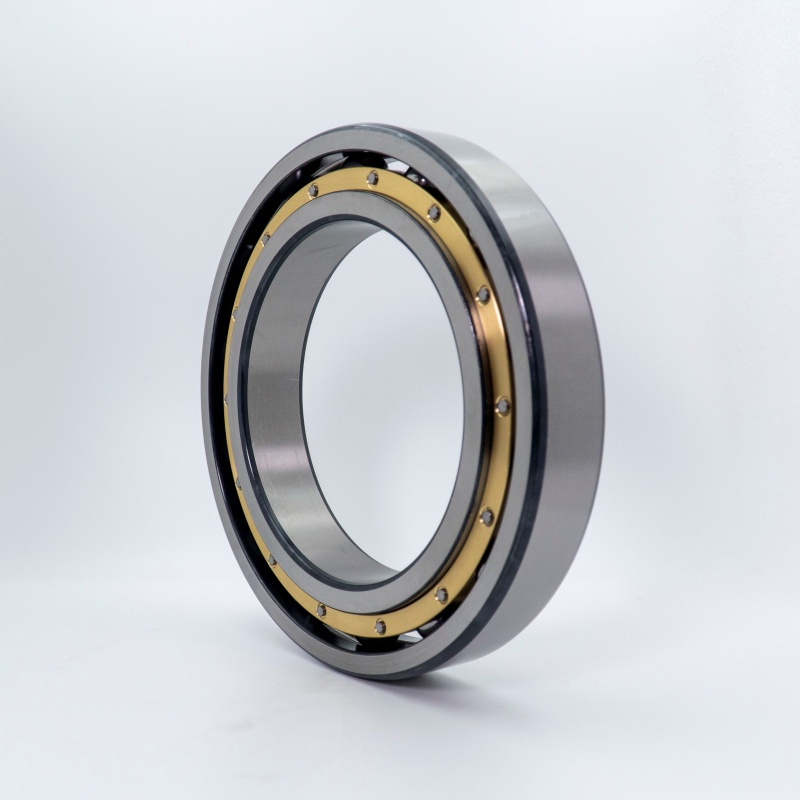
This is a question we often hear from maintenance teams, and the answer lies in the pote a internal geometry. A standard radial bearing, such as a Deep Groove boul pote oswa yon Silendrik roulo, has raceways that are designed to support forces coming from the side (radially). While gwo twou san fon Groove boul BEARINGS can handle some light or intermittent thrust load due to the depth of their grooves, they are not optimized for it.
When you apply a significant axial force nan yon radial ball bearing, you force the balls to ride up the side of their raceway grooves. This concentrates the entire chay onto a very small, elliptical contact area on the edge of the raceway. This leads to extremely high stress, a breakdown of the lubricant film, a rapid increase in friksyon and heat, and ultimately, catastrophic palye failure. A Silendrik roulo is even less suited for this, as its flat-ended rollers have virtually no ability to handle an axial load. Forcing a radial bearing to do the job of a thrust bearing is one of the most common and costly application errors we see.
What is a Thrust Bearing and How Is It Structurally Different?
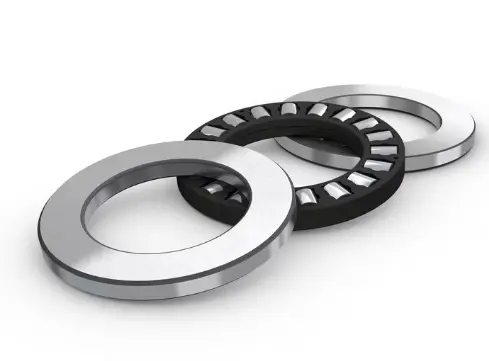
A thrust bearing is a special Kalite pote designed specifically to manage a high axial load. Unlike a radial bearing where the rings are concentric, a thrust bearing is designed like a sandwich. It consists of two washer-like rings, called shaft and housing washers, with a set of rolling elements (either a ball or roller) held by a cage in between.
Here's how it works:
- A chay is applied parallel to the bwa.
- The force is transmitted from one washer, through the rolling elements, to the other washer.
- The rolling motion of the balls or rollers allows the bwa to rotate with minimal friksyon while under a heavy axial force.
This design ensures that the thrust load is distributed evenly across the rolling elements in the way they were designed to handle it. A thrust bearing is the only correct choice for applications with a pure or predominantly axial load. They are sometimes referred to as axial bearings for this reason. The entire construction of this palye is focused on handling loads parallel nan la bearing axis.
What are the Common Types of Thrust Bearings?
Just as there are different types of radial bearings, there are also several common types of thrust palye. The choice depends on the application's specific requirements for load capacity, speed, and precision. The main distinction is based on the shape of the rolling element used inside the palye.
The primary categories for this type of thrust bearing are:
| Type of Thrust Bearing | Rolling Element | Karakteristik kle yo |
|---|---|---|
| Vyolans boul pote | Ball | Higher speed, lower friction, suitable for lighter axial loads. |
| Cylindrical Roller Thrust | Cylindrical Roller | High axial load capacity, good for heavy, slow applications. |
| Spherical Roller Thrust | Barrel-shaped Roller | High axial load capacity and can accommodate misalignment. |
| Tapered Roller Thrust | Tapered Roller | Very high axial load capacity, often used in large machinery. |
| Thrust Needle Bearing | Needle Roller | Very compact design for applications with limited space. |
Each of these bearing types has a specific role. A thrust ball bearing is excellent for a high-speed spindle, while a spherical roller thrust bearing is essential for a rock crusher where both a high load and misalignment are present.
Thrust Ball Bearings: When Are They the Right Choice?
Thrust ball bearings are the ideal solution when the primary requirement is managing a moderate axial load at relatively high speeds. Because the rolling element is a ball, this palye has a lower coefficient of friksyon compared to a roller thrust bearing. This allows them to operate more efficiently at higher RPMs without generating excessive heat.
Thrust ball bearings are used in applications such as:
- Machine Zouti Spindles: Where precision and speed are critical under a moderate thrust load.
- Automotive Clutch Mechanisms: To handle the axial force of engaging and disengaging the clutch.
- Rotating Tables and Indexers: Providing smooth rotation while supporting the vertical weight of the table.
It's important to note that a standard thrust ball bearing cannot handle any radial load. If there is any radyal component to the force, the palye will be damaged. They are purely for axial load applications. A bearings are designed to handle force in one direction, although double-direction thrust ball bearings are available which can support axial loads in two directions.
Roller Thrust Bearings: The Solution for High Load Capacity?
When you are dealing with a high axial load, a roller thrust bearing is the answer. Instead of the point contact of a boul pote, a Portant roulo provides a line of contact. This allows the palye pou distribute loads over a larger area, giving it a much higher load capacity. This makes the ou type essential for heavy-duty industrial machinery.
There are several types of roller thrust bearings, each suited for different demanding scenarios:
- Cylindrical Roller Thrust Bearings: These use cylindrical rollers and can handle very heavy loads. They are stiff and require precise alignment, making them suitable for applications like screw-down mechanisms in steel mills. The cylindrical roller provides a large contact patch for the axial load.
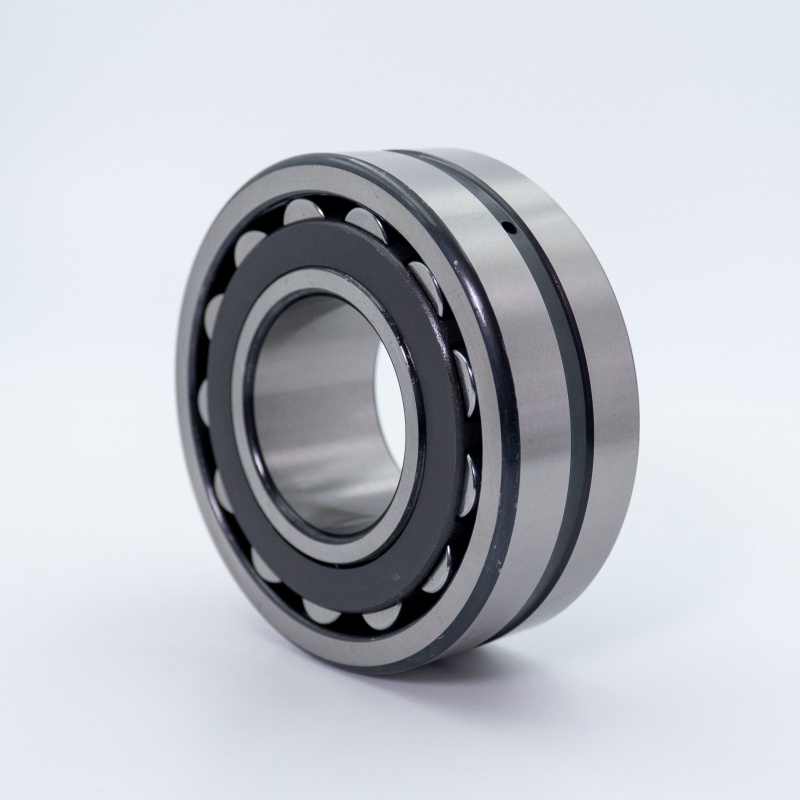
- Spherical Roller Thrust Bearings: These are a true powerhouse. They use barrel-shaped rollers that allow them to handle an extremely high axial load while also accommodating shaft misalignment. This self-aligning capability makes them indispensable in applications like extruders, gearboxes, and cranes where perfect alignment cannot be guaranteed.
- Tapered Roller Thrust Bearings: A kon woule woule designed for thrust applications has the highest kapasite chaj aksyal of all. The tapered roller geometry is ideal for managing immense forces, and they are often found in oil and gas drilling equipment and other extreme load applications.
Choosing a Portant roulo means prioritizing strength. They can carry much heavier thrust loads than ball bearings of a similar size.
What About Combined Loads? Which Bearing Can Handle Both?
In the real world, forces are rarely purely radyal or purely axial. Most applications involve combined loads—a mix of both thrust and radial loads. So, which bearing can handle this? A standard radial bearing can't handle the thrust, and a standard thrust bearing can't handle the radyal. This is where angular contact bearings come in.
Yon angular contact ball bearing is specifically designed to handle loads simultaneously. The raceways are offset, creating a contact angle that allows the palye to support a significant thrust load in addition to a radial load. They are the perfect solution for applications like high-speed pumps, compressors, and machine tool spindles where both axial and radial loads are present. A single angular contact bearing can only take an axial load in one direction, so they are often mounted in pairs to handle forces from both directions.
For even heavier combined loads, the kon woule woule is the champion. Its conical rollers and raceways are inherently designed to accommodate high radyal ak segondè thrust load. This is why they are the standard palye for vehicle wheel hubs and heavy-duty gearboxes. The choice between an angular contact ball bearing and a kon woule woule often comes down to the magnitude of the chay and the required speed. While some radial bearings like a Deep Groove boul pote can handle light combined loads, an angular contact bearing is the correct engineering choice when significant axial loads are involved.
What are the Key Bearing Loads to Consider in Your Application?
As a pragmatic manager, you need a clear checklist to choose the best bearing. When evaluating an application, especially one with a potential thrust load, you must analyze the bearing loads in detail. Simply replacing a failed palye with the same part number without understanding the forces involved is a recipe for repeat failure.
Here are the key factors to consider:
- Load Magnitude: What is the actual force in pounds or newtons? Is it a light load suitable for a boul pote, or a heavy load that demands a Portant roulo?
- Load Direction: Is the load purely radyal, purely axial (presyon), or a combination of both? This is the most critical question that will guide your initial palye choice.
- Load Type: Is the chay steady and constant, or is it a shock/impact load? Applications with high impact, like rock crushers, require a robust palye like a spherical Portant roulo.
- Speed: What is the rotational speed (RPM) of the bwa? This will influence whether a boul pote (higher speed) or a Portant roulo (lower speed, higher load) is more appropriate. Every palye has a speed rating that should not be exceeded. For primarily radial load applications at high speeds, a Silendrik roulo can be an excellent choice, often paired with a separate thrust bearing.
By carefully analyzing these four aspects of the chay, you can confidently select the appropriate bearing for the job.
How Does Load Direction Define Your Bearing Selection?
Ultimately, the entire process of choosing the correct type de palye boils down to one simple principle: match the palye nan la load direction. A palye you choose must be designed to accommodate the primary forces it will experience during operation.
Here is a simplified decision-making table to help you choose the best bearing based on load direction:
| Primary Load Direction | Recommended Bearing Types | Key Considerations |
|---|---|---|
| Purely Radial | Deep Groove Ball Bearing, Cylindrical Roller Bearing, Needle Roller | Choose ou for higher loads, ball for higher speeds. |
| Purely Axial (Thrust) | Thrust Ball Bearing, Spherical/Cylindrical/Tapered Roller Thrust | Choose ou pou high axial load, ball for higher speeds. |
| Combined Radial & Axial | Angular Contact Ball Bearing, Tapered Roller Bearing, Spherical Roller | Angular contact for speed/precision, tapered/spherical roller for heavy duty. |
This table serves as a fundamental guide. Of course, other factors like bearing size, speed ratings, and environmental conditions must also be considered. But starting with the load direction will always point you toward the right family of palye solutions and prevent the most common and damaging application errors. A bearing is designed for a purpose; using it correctly is the key to reliability.
Partnering for Reliability: Choosing the Right Bearing Supplier
Chwa ou nan palye supplier is just as critical as your choice of bearing type. A reliable partner does more than just sell you a part; they provide the quality assurance and technical expertise to ensure that the palye you install will meet the requirements of the application.
As an ISO9001-certified manufacturer with over a decade of experience, we at VPK Bearing understand the immense pressure on MRO and procurement managers. Your company's profitability depends on operational uptime, and that uptime depends on the reliability of components like the palye. We are committed to being a partner in your success by:
- Manufacturing Excellence: We use high-grade steel and maintain strict quality control to produce every palye, from a standard boul pote to a heavy-duty Portant roulo, to exacting standards.
- Technical Support: We can help you analyze your bearing loads ak help you choose the best palye for your specific needs, ensuring you don't just get a replacement, but the right solution.
- Kalite ki konsistan: Our rigorous processes ensure that the palye you receive today performs identically to the one you receive next year, eliminating the quality inconsistencies that lead to unpredictable failures.
When it comes to handling a thrust load, making the right palye choice is non-negotiable. Partner with a manufacturer who understands the stakes and is committed to delivering the reliability you depend on.
Kle takeaways sonje
- Radial load is perpendicular to the bwa; thrust load (axial load) is parallel to the bwa.
- A standard radial bearing cannot handle a significant thrust load and will fail quickly if used improperly.
- A thrust bearing is specifically designed with washer-like rings to manage high axial load.
- Thrust ball bearings are best for moderate loads and higher speeds, while roller thrust bearings are required for heavy loads.
- For combined loads (both radyal and axial), an angular contact ball bearing oswa yon kon woule woule is the correct choice.
- Always select a palye based on a careful analysis of the load's magnitude, direction, type, and the operational speed.
Post time: Dec-15-2025