
As a Senior Procurement or MRO Manager, you are the gatekeeper of your operation's reliability. You know that in heavy machinri, performance isn't just a goal; it's a necessity. When a critical component fails, the consequences are immediate and expensive. This guide is your definitive resource on one of the workhorses of the industrial world: the Silendrik roulo. We will explore what makes this Kalite pote so powerful, how its cylindrical rollers provide immense strength, and how to select the right cylindrical roller bearing for your most demanding applications. At VPK Bearing, we believe in empowering our partners with knowledge, and this article will provide the clarity you need to make informed decisions that enhance performance and prevent costly downtime.
What is a Cylindrical Roller Bearing and How Does it Work?
A Silendrik roulo is a specific type of roller bearing that uses cylindrical rollers as its rolling elements. Unlike BEARINGS boul, which use spherical balls, this palye leverages the geometry of a cylinder to support and guide rotating parts. The fundamental principle is to reduce friction between a rotating shaft and a stationary housing, but its design is purpose-built for strength. The cylindrical rollers are positioned between an inner and bag ekstèn, held in place by a cage that ensures they are evenly spaced and track correctly.
The operation is straightforward but powerful. As the inner bag rotates with the shaft, the cylindrical rollers roll along the precisely machined tracks, or raceways, of both the inner and outer rings. This rolling motion has significantly less friksyon than the sliding friksyon that would occur without a palye. This design is specifically optimized to handle very high radyal forces. Imagine the immense weight of a large industrial gearbox; a Silendrik roulo is engineered to support that kind of heavy radial load with exceptional rigidity and minimal deformation. This makes it a foundational component in countless heavy-duty applications.
The internal design of these bearings can vary. Many BEARINGS roulo silendrik are separable, meaning the inner or outer ring can be removed from the ou ak cage assembly. This is a significant practical advantage, as it simplifies mounting and dismounting, especially in tight spaces. This feature, combined with their raw strength, makes the Silendrik roulo a favorite among maintenance engineers and machine designers.
How Do Cylindrical Rollers Provide Superior Radial Load Capacity?
The secret to the immense strength of a Silendrik roulo lies in its contact geometry. This is the key difference between a Portant roulo ak yon boul pote. Youn boul pote makes a single point of contact with its raceways. This is great for low friksyon and high speeds, but it concentrates the entire chay onto a very small area.
A Silendrik roulo, however, makes a line of contact. Each of the cylindrical rollers creates a line of contact with the raceways nan la inner and outer rings. This simple change from a point to a line dramatically increases the contact area. Think about it: the same force distributed over a much larger surface area results in significantly lower pressure and stress on the palye materials. This is why BEARINGS roulo silendrik are renowned for their high radial load capacity.
Sa larger contact area compared pou BEARINGS boul means they can handle heavy radial loads without succumbing to fatigue. This characteristic is what allows them to perform reliably in demanding environments like steel mills, mining operations, and large industrial gearboxes. The load carrying capacity nan yon Silendrik roulo is its primary advantage, providing the rigidity and strength necessary to keep heavy machinri running smoothly even under heavy loads. This design ensures a longer service life precisely because it manages stress so effectively.
What Are the Main Types of Cylindrical Roller Bearings?
Se pa tout BEARINGS roulo silendrik are created equal. To meet the diverse demands of industrial applications, they come in several designs. Understanding these variations is crucial for selecting the right cylindrical roller bearing. The main differences lie in the configuration of the flanges on the rings and the design of the cage.
The primary types of cylindrical roller bearings you'll encounter are:
- Single Row Cylindrical Roller Bearings: This is the most common type. They possess a high kapasite chaj radial and are suitable for gwo vitès. They come in several designations (NU, NJ, NUP, N) which indicate the flange configuration and their ability to handle some incidental axial load. For example, an NU type palye has flanges on the bag ekstèn but not the inner, allowing for axial displacement of the shaft relative to the housing.
- Double Row Cylindrical Roller Bearings: For applications demanding even higher radial load capacity, a double row palye is the solution. As the name suggests, they have two rows of rollers, nearly doubling the load carrying capacity in a compact design. They are often used in machine tools and rolling mills where extreme rigidity is required.
- Full Complement Cylindrical Roller Bearings: These bearings are designed for maximum load capacity. They do away with the cage and instead fill the space between the rings with as many cylindrical rollers as possible. While this provides the ultimate high radial load capacity, the rubbing between the rollers creates more friksyon, making them suitable only for lower-speed applications.
A cage itself is also an important component. It can be made from pressed steel for general applications, or from machined brass or polyamide for more demanding conditions involving high speeds or vibrations. The choice of cage material can significantly impact the palye's performance and service life.
What is a Cylindrical Roller Thrust Bearing Used For?
While standard BEARINGS roulo silendrik are masters of radial load, they are not designed to handle significant direct axial load. When an application involves heavy axial loads, you need a completely different design: a cylindrical roller thrust bearing. This is a specialized type of thrust bearing engineered specifically to manage forces that are parallel to the shaft.
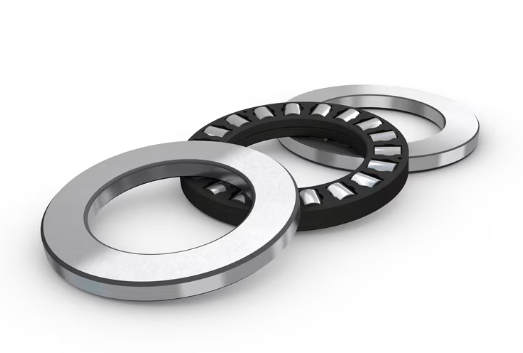
A cylindrical roller thrust bearing is composed of two flat, washer-like rings (a shaft washer and a housing washer) with raceways, and a cage assembly containing cylindrical rollers. A rollers in a thrust bearing are oriented with their axes perpendicular to the shaft's axis. When an axial load is applied, it is transmitted from one washer, through the ends of the cylindrical rollers, to the other washer. Because the ends of the rollers provide a large, flat contact area, this thrust bearing can sustain very heavy axial loads.
Roller thrust bearings are designed to provide a high degree of stiffness and are ideal for applications where axial space is limited. You will find this robust thrust bearing used in applications like crane hooks, oil well swivels, and extruder gearboxes. A cylindrical roller thrust bearing is the go-to solution when you need to support massive thrust forces while allowing for rotation. It's a prime example of how a specific Portant roulo is engineered to solve a very specific problem.
How is a Cylindrical Roller Bearing Different from a Ball Bearing?
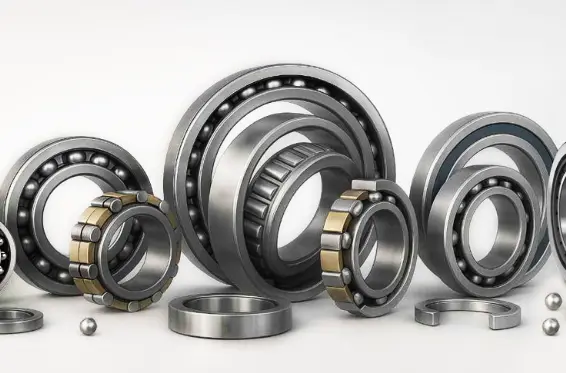
For a procurement manager, understanding the fundamental differences between a Silendrik roulo ak yon boul pote is essential for making cost-effective and reliable purchasing decisions. The choice between these two main palye types will have a significant impact on the performance and longevity of your equipment.
Here is a direct comparison:
| Patikilarite | Silendrik roulo | Ball Bearing |
|---|---|---|
| Contact Type | Line Contact | Point Contact |
| Primary Load | Very High Radial Load | Moderate Radial ak Axial Load |
| Speed Capability | Moderate to High Speeds | Very High Speeds |
| Friction | Low, but slightly higher than a boul pote | Very Low |
| Rigidity | Very High | Moderate |
| Misalignment | Very low tolerance for misalignment | Some types (e.g., self-aligning) can handle significant misalignment |
| Common Use | Heavy industrial gearboxes, large motors, construction equipment | Electric motors, pumps, power tools, otomobil applications |
In essence, the decision comes down to chay versus speed. If your primary challenge is to handle heavy radial loads, a Silendrik roulo is almost always the superior choice. Its line contact provides a higher load capacity and greater stiffness. Compared to ball bearings, a Silendrik roulo offers unmatched strength. However, if the application involves very high speeds or a mix of moderate radial and axial loads, a Deep Groove boul pote might be the more suitable and efficient option. Knowing this distinction prevents specifying the wrong palye and avoids premature Portant echèk.
What Are the Key Applications of Cylindrical Roller Bearings?
The robust nature and high radial load capacity of BEARINGS roulo silendrik make them indispensable in a wide variety of industrial applications. They are the silent workhorses found at the heart of the most powerful and productive equipment. When you see a machine designed to move heavy things or withstand immense forces, there is a very good chance it relies on BEARINGS roulo silendrik.
Some of the most common applications of cylindrical roller bearings include:
- Industrial Gearboxes: They are used to support gears and shafts, handling the high torque and radyal forces generated during power transmission.
- Large Electric Motors: The drive end of large motors often uses a Silendrik roulo to support the heavy rotor and the belt-pull forces.
- Woule moulen: In steel production, these bearings withstand the incredible forces required to shape hot metal.
- Construction and Mining Equipment: Crushers, conveyors, and the transmissions of heavy vehicles all rely on the durability of this Portant roulo type.
- Vibrating Screens and Pumps: They are used in applications that involve heavy, vibrating loads.
- Machine Tools: The spindles of lathes and milling machines use high-precision double-row BEARINGS roulo silendrik for their exceptional rigidity.
In each of these cases, the Silendrik roulo is chosen because it provides a reliable, long-lasting solution that can handle heavy loads day in and day out. This reliability is exactly what MRO managers need to ensure operational continuity.
Can a Standard Cylindrical Roller Bearing Handle Axial Loads?
This is a critical question and a common point of confusion. The answer is: it depends entirely on the specific design of the Silendrik roulo. A standard NU or N design palye, which has flanges on only one ring, cannot support any axial load. In fact, they are often used in "locating/non-locating" arrangements specifically to accommodate thermal expansion of a shaft.
However, BEARINGS roulo silendrik of the NJ and NUP designs are engineered to handle some axial load.
- NJ Type: Sa palye has two flanges on the bag ekstèn and one on the bag enteryè. This allows it to locate the shaft axially in one direction. It can handle incidental or light axial loads in one direction.
- NUP Type: Sa palye has two integral flanges on the bag ekstèn and one integral flange and one loose flange ring on the bag enteryè. This design allows it to be used as a locating palye, constraining the shaft in both axial directions.
It is crucial to understand that even these designs are not meant for heavy, continuous axial load. Their kapasite chaj aksyal is a fraction of their radyal capacity. If your application involves significant or primary Charj aksyal, the correct choice is a dedicated thrust bearing (like a cylindrical roller thrust bearing) or a different type of roller bearing like a tapered or spherical roller bearing. Using a standard Silendrik roulo in a high-thrust application is a recipe for rapid failure.
Why Might a Slewing Bearing Be a Better Choice in Some Cases?
While our focus is on the Silendrik roulo, it's important to be aware of other specialized types of roller bearings for unique applications. One such example is the slewing bearing (also known as a turntable bearing). A slewing bearing is a large-diameter palye designed to handle a complex mix of heavy radial and axial loads, as well as tilting moments.
Imagine the motion of a crane or an excavator. The turret rotates on its base, all while supporting the immense weight and leverage of the boom. This is the perfect application for a slewing bearing. Unlike a standard Silendrik roulo, which fits onto a shaft, a slewing bearing is typically bolted directly onto two different structural surfaces.
These complex bearings often incorporate gear teeth on their inner or outer race, integrating them directly into the machine's drive system. They can use cylindrical rollers, balls, or a combination as their rolling elements. So, while a Silendrik roulo is perfect for supporting a high-speed rotating shaft, a slewing bearing is the solution for slow-rotating, high-load applications like cranes, wind turbines, and radar antennas where you need to manage complex, multi-directional forces.
What are the Tips for Selecting the Right Cylindrical Roller Bearing?
Selecting the right cylindrical roller bearing is a critical task that directly impacts machine reliability and service life. As a procurement manager, you can ensure success by working through a systematic checklist of application requirements. Don't just replace a failed palye with the same part number; take the opportunity to verify that it was the right bearing in the first place.
Here are some key tips for selecting the perfect Portant roulo:
- Analyze the Load: Quantify the radial load a palye must support. Is it steady, or does it involve shock and vibration? This is the single most important factor determining the size and type of Silendrik roulo needed.
- Consider the Speed: Check the required rotational speed (RPM). Ensure the selected palye's limiting speed is higher than the application's operating speed. Full complement bearings have lower speed limits than those with a cage.
- Assess Axial Conditions: Determine if the palye needs to accommodate axial shaft expansion (use an NU type) or if it needs to locate the shaft and handle light thrust (use an NJ or NUP type). Remember, for heavy axial load, you need a thrust bearing.
- Evaluate Operating Environment: Consider the temperature, contamination levels, and potential for moisture. This will influence the choice of internal clearance, cage material, and sealing/shielding requirements. Proper grese is also dictated by the environment.
- Check for Misalignment: Cylindrical roller bearings have very little tolerance for misalignment. If the shaft can deflect or if housings are not perfectly aligned, a different Kalite pote (like a spherical roller bearing) may be necessary. For these situations, a specialized spherical roller bearing is often the best choice.
- Consult Manufacturer Data: Always refer to the technical data sheets from a reliable manufacturer like VPK Bearing. They provide detailed information on load capacity, speed ratings, and dimensions. Using a high-quality Silendrik roulo specified by the manufacturer is your best guarantee of performance.
Why is Material Choice, like Stainless Steel, Important for a Bearing?
The material a palye is made from is the foundation of its performance. For the vast majority of BEARINGS roulo silendrik, a high-carbon chromium bearing steel is the material of choice. When properly heat-treated, this steel offers an exceptional combination of hardness, fatigue resistance, and durability, making it ideal for handling the high contact stresses inside a Portant roulo.
However, there are environments where standard steel is not suitable. This is where alternative materials like stainless steel become critical. A stainless steel cylindrical roller bearing is the perfect solution for applications exposed to moisture or corrosive chemicals. These bearings are used in applications in the food and beverage industry, chemical processing, and marine environments. While stainless steel may have a slightly lower load capacity than standard bearing steel, its ability to resist rust and corrosion can lead to a much longer service life in these specific conditions.
For even more extreme environments, bearings can be made with materials like stainless steel or ceramic rollers. The point is that the material must be matched to the application. A reliable manufacturer will always use high-purity, properly heat-treated steel as a standard and will be able to provide bearings in specialty materials when required. Investing in a palye made from the appropriate material is a key strategy in preventing premature failure and reducing long-term maintenance costs. While BEARINGS boul like the Deep Groove boul pote are versatile, the material choice is just as critical for them in harsh environments.
Kle takeaways sonje
- A Silendrik roulo is designed for one primary purpose: to handle very high radial loads with exceptional rigidity.
- Its strength comes from the line contact between its cylindrical rollers and raceways, which distributes the chay over a larger area compared to ball bearings.
- There are various types of cylindrical roller bearings, including single row, double row, and full complement, each offering different levels of load capacity and speed capability.
- For heavy axial loads, a specialized cylindrical roller thrust bearing is required. Standard BEARINGS roulo silendrik have limited or no thrust capability.
- Selecting the right bearing involves a careful analysis of the radyal ak axial loads, speed, alignment, and operating environment.
- The quality of the material, typically high-carbon chromium steel, is fundamental to the pote a performance and service life. Partnering with a quality-focused manufacturer is your best defense against premature failure.
Post time: Dec-02-2025